
Technical Polish Missing, Start Confusing: Key Data & Clips from Liverpool vs PSG
Liverpool were only better for 40 minutes than PSG in the whole tie, definitely not enough to go through.

Before I start the article, today is a poignant day: the 37th anniversary of the Hillsborough disaster. Gone, but never forgotten. #JFT97 ❤️
Well, there you have it. The task that looked improbable turned out to be exactly that, as Liverpool bow out to Paris Saint-Germain (PSG) in the Champions League quarter-final with an aggregate score of 0–4. Although the 0–2 defeat in the second leg at Anfield is not a true reflection of what happened in the game, especially between minutes 35 and 65, the Parisians had missed enough chances in the first leg to suggest they deserved some degree of ‘luck’ while defending a two-goal lead away from home.
Arne Slot took a risk by not starting Mohamed Salah and instead giving Alexander Isak the nod to start alongside Hugo Ekitike in a 4-4-2 diamond-like system. While I understood that to an extent (unleashing a fresh Salah in the second half), announcing before kick-off that Isak would only play 45 minutes signalled to everyone that the Swede was not fully fit and that the manager was only partially accommodating him in the line-up to build up his minutes.
The first 30 minutes of the second leg were supposed to be the period when Liverpool pinned PSG back and, hopefully, found the opening goal of the night. That did not happen, and during that spell, the away side looked relatively comfortable, while the home side huffed and puffed but lacked technical quality.
After losing Ekitike to a serious injury (feel for the lad), the Reds and Arne Slot stumbled upon a more effective system, with Mohamed Salah coming on the right wing and immediately changing the trajectory of the game.
Let’s look at some of the numbers from this game with the help of visuals before going through some of the in-game clips.
In-game Data
Start with the passing in each 15-minute phase of the game, layered with expected threat (xT), so that the connections are not just defined by passing frequency, but also by the threat generated.
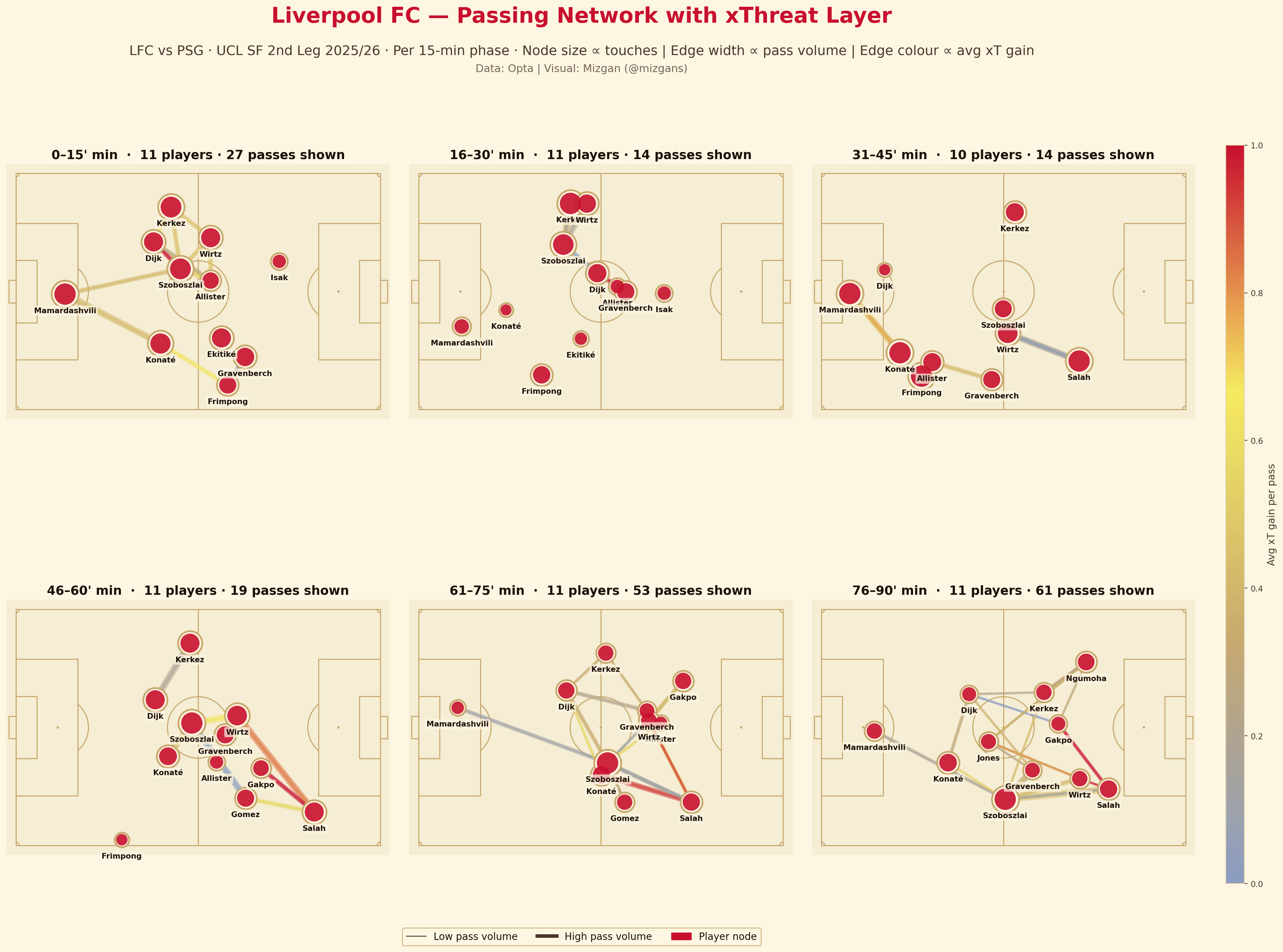
Looking at the passing network from the first 30 minutes, Isak, who had just five touches in the game (his game lasted 45 minutes), one of which came from an attacking corner, was not heavily involved in the passing sequences. Salah came on after the 30-minute mark and immediately became a central figure in the team’s threat generation.
The passing network in the opening half-hour reflects a side that has not played together much, with the striker often left isolated and disconnected from midfield support.
The structure looked much more cohesive on the ball in the second half as well, with Florian Wirtz drifting inside and linking up frequently with Salah. We will see a clip later in this article that illustrates this in more detail.
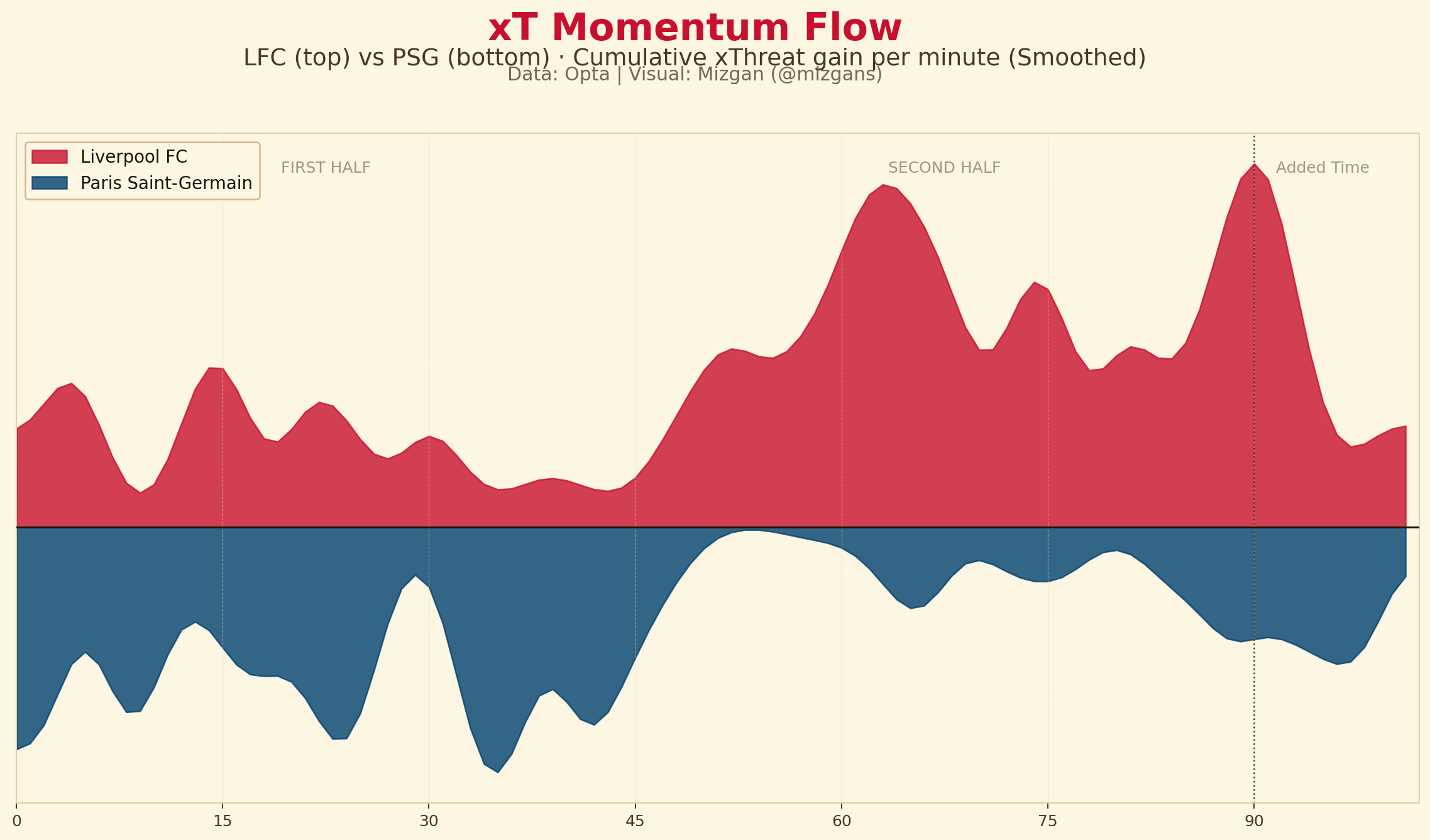
As discussed earlier, Liverpool did not start the game as one would have expected. However, they grew into it and dominated proceedings after half-time. They registered 17 shots to PSG’s four in the second half, although those 17 shots only produced an xG of 1.53. That means the xG per shot was just 0.09, which is very low. Seven of those attempts came from outside the box.
So, while the Reds were able to generate more threat for much of the second half, they were not able to convert those moments into higher-quality chances. This is where the lack of technical quality came to the fore.
Although Cody Gakpo was more effective as a number nine than a half-fit Isak, they missed the presence of Ekitike. Salah was doing all he could, but it is clear he no longer has that same killer touch inside the opposition box. Wirtz’s performance was synonymous with the season: flashes of quality, but also missing the final ball at times. Not all his fault though!
Or, you can become a monthly member/buy me a coffee or two every month. Coffee Page here.
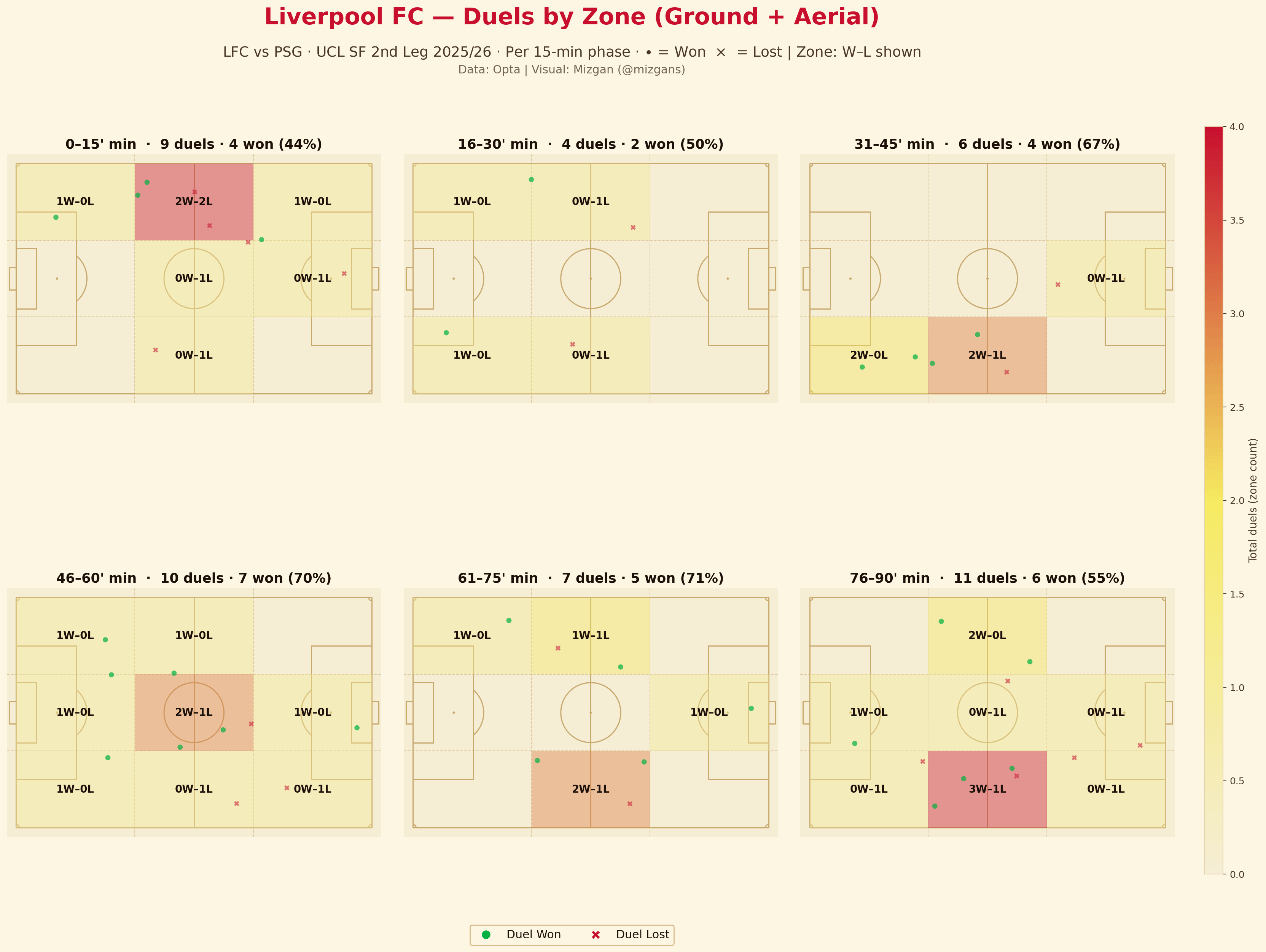
Given the nature of the game discussed earlier, it is no surprise that the higher proportion of duel-winning came between minutes 30 and 75 for Liverpool. Especially in the 15-minute spells either side of half-time, they were very strong in duels.
However, the tone of the first 30 minutes was not set in the right manner. Being strong for a 40–45 minute period will never be enough to progress past PSG over two legs.
In-game Clips
This section contains half a dozen in-game clips that show how it all unfolded, highlighting both the good and the bad moments from a Liverpool viewpoint.
Please note that this is an observational analysis rather than an attempt to critique the coaching style of someone like Arne Slot.
Liverpool’s narrow shape meant PSG’s rampaging wingers were always going to be in one-v-one situations in wide areas, with limited support for the likes of Jeremie Frimpong. Once Ryan Gravenberch stepped out of midfield, it vacated space centrally for Warren Zaïre-Emery to receive possession and have a shot on goal.
The clip highlights a recurring issue for Arne Slot’s side regardless of the pressing structure in place: passiveness.
A man-to-man pressing system that is applied with a passive edge means that good technical teams can simply play through or around it, as Paris Saint-Germain did in the first leg, and again in the opening 30 minutes of the second leg.
The shape would have worked better had the Reds got hold of the ball from the start and made that count by playing centrally before switching out to the fullbacks. They tried, but those occasions were few and far in the first 30 minutes.
Talking about getting hold of the ball, let’s look at a few clips showing how the team lacked technical quality to sustain possession in the opposition half, especially in the first 30 minutes.
After seeing Ibrahima Konate win the ball in a decent position, why did Frimpong not play a simple five-yard pass into Dominik Szoboszlai to keep the ball in the opposition half? Instead, he went all the way back to Gravenberch, who then played it back to the goalkeeper. That is how you relinquish territory even while having possession.
PSG did well to stop Frimpong from getting a yard of space to deliver a cross into the box. However, Liverpool’s shape meant there was no natural winger for him to combine with in a quick one-two. Gravenberch was available, but he is not a natural wide option.
The move eventually broke down and the ball was recycled all the way back to Giorgi Mamardashvili, whose subsequent long pass forward was the worst possible in that moment. The Georgian’s distribution remains a concern.
Things got better as soon as Salah arrived and the shape was forced to be changed. As we saw in the xT momentum flow, Liverpool’s best phase was 10 minutes before half-time and 30 minutes after half-time.
Although it came from a second phase of a set-piece, Salah delivered an immediate impact from the wing with an excellent cross. Only a goal-saving tackle from Marquinhos prevented Virgil van Dijk from scoring. Liverpool had lacked quality deliveries into the box prior to this moment.
Things got better in the second half, with a lack of quality when it came to the final ball (discussed when talking about the numbers).
These type of half-cleared balls weren’t sticking with the front men in the first half. But, Salah’s cushioned header down for Gakpo, who had a decent game as a nine (barring odd decision-making later on), meant that the Reds were able to sustain an attack before Milos Kerkez not showing enough composure with the ball.
The phase shown above started with a very good line-breaking pass from Konaté to Wirtz, who linked up well with Salah on the right-hand side.
Although PSG cleared the initial danger, Konaté was strong against Ousmane Dembélé to recover possession and sustain the attack. The phase eventually ended with Liverpool winning a corner.
This was symptomatic of what unfolded in the opening 25 minutes of the second half. The issue, however, was that it did not translate into a goal or a significant volume of big chances. That is where Liverpool may have lacked a sharp Isak, or, had Ekitike not been injured, he might have made a difference as well. Gakpo linked play well, but his final action was not at the required level either.
I know it sounds a bit cliché, but had Liverpool played like this in even 50% of the Premier League games where they dropped points, they might have had 10 more points on the board and would not be jostling for position in the Champions League spots with six games to go.
That is the situation now as the Reds head to the Hill Dickinson for the first Merseyside derby there. Expecting a win would be foolish, but it is a must-not-lose game for Arne Slot and his team.
That Frimpong back pass that you highlighted, instead of going forward with a pass to the totally free SoBoss was highly revealing of the mentality engendered by Slot, imo. You think how much emphasis Klopp used to put on taking responsibility himself for failed progressive moves - 'it's on me'. Frimpong is a naturally bubbly, flair player who needs that kind of backing and confidence boost. Instead we've had so many of our players playing within themselves. Slot won the league last year because he didn't have to do anything in terms of boosting player confidence - in fact it probably helped to have him bringing his hands off style of management - just tweaking the tactics.
Another thing I noticed from the passing charts is how little action took place out on the left. To be honest, I think there should be more criticism with how the club as a whole has neglected the obvious problems we've had here. Selling Diaz was a disaster. Even when he was used centrally it did wonders for Gakpo's effectiveness. But thinking that playing Ekitike and Isak as a 2 and completely failing to address the problems of not stretching the play out on the left seems like borderline criminal to me. You can see when Rio's out there that we immediately have addressed that problem and whichever full back or midfielder is with him can start to use that space. MacAlister's poor form and the erratic use of Jones hasn't helped either, but the recruitment was awful in retrospect. Incoherent. The knock on effects of that waste of space are just endless.